


HISTORICAL MEMORY CANNOT BE DISMANTLED, HISTORY CANNOT BE CENSORED
Manifesto in Defense of the National Museum of Colombia, Cultural Heritage, and Historical Memory
We have received with profound indignation and concern the news of the removal of more than thirty objects from the galleries of the National Museum of Colombia, related to the memories of political violence, feminist movements, struggles for LGBTQ+ rights, the 1991 Constitution, and the 2016 Peace Agreement.
As anthropologists, public historians, museum professionals, and researchers of historical memory, several of whom have maintained close academic and professional relationships with the National Museum of Colombia, we consider it essential to speak out against these developments.
Some of us, researchers affiliated with the Latin American Public History Network, which brings together scholars from several countries across the region, have devoted much of our professional careers to studying how Colombian museums represent difficult pasts, violence, and the memories of those who were excluded from official historical narratives for decades. For this reason, these developments deeply concern us, not only as public historians but also as Colombians and Latin Americans committed to defending cultural heritage and the right to memory.
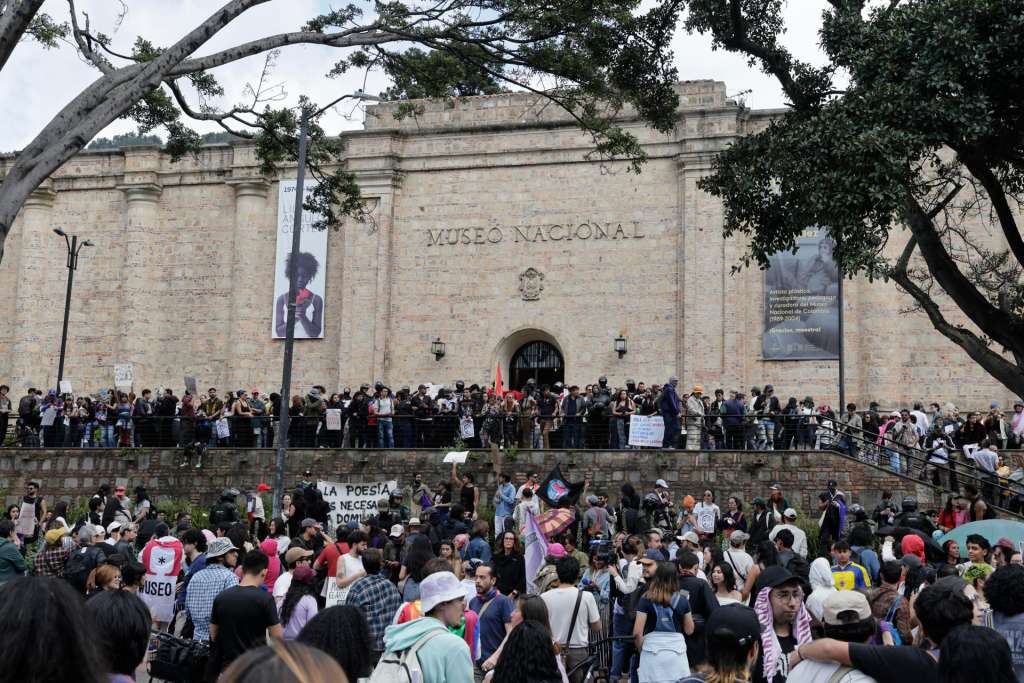
Picture taken by Carlos Ortega for El Espectador Newspaper during the October 17, 2026, protest.
A National Museum does not belong to the government currently in power. It is a public institution that serves society as a whole. Its responsibility is not to construct a single, convenient historical narrative for those who hold political power, but rather to collect, safeguard, research, and encourage discussion about the complexities of our past.
Museums also exist to make us uncomfortable, to challenge us, and to confront us with what we might prefer to forget. Colombia’s history has been shaped by conflicts, exclusion, violence, resistance, and struggles for rights. Removing the material traces of these experiences from exhibitions does not change what happened. It merely impoverishes our possibilities of understanding it.
Cultural heritage is not limited to objects celebrating what a small segment of society considers national glory. It also includes the testimonies of victims, social struggles, peace processes, expressions of resistance, and the memories of those who have historically been silenced. These memories are also Colombia.
It is particularly troubling that, according to media reports, these decisions were made following political instructions and without the appropriate curatorial procedures. The professional autonomy of museums is not merely a privilege enjoyed by their employees; it is also a safeguard for society as a whole. Decisions about what is exhibited, how it is interpreted, and why an exhibition is transformed must be guided by historical, museological, ethical, and academic criteria, rather than ideological impositions.
Museums, of course, must evolve. Their narratives must be continuously reviewed, debated, and enriched. However, there is a fundamental difference between critically revising an exhibition and removing content because it makes those in power uncomfortable. Museological revision expands the possibilities of interpretation; censorship restricts them.
Colombia knows the consequences of silence all too well. For decades, countless individuals and communities have struggled to have their experiences of violence, exclusion, resistance, and their struggles to secure basic civil rights publicly recognized. The progress achieved in representing these memories—through broad social reflection, different cultural policy frameworks, and research processes—cannot be subjected to the political preferences of a particular administration.
 Picture taken by Sebastián Vargas during the October 17, 2026, protest.
Historical memory is collective. It does not belong to a president, a minister, or a political party. It belongs to a society that has the right to know, question, and debate its past from multiple perspectives. This is precisely what the National Museum has sought to accomplish through its museological processes over the past twenty years, involving consultation, broad and diverse professional teams, and the participation of social organizations.
We therefore consider it essential to demand public explanations regarding the reasons for removing these objects, the criteria applied, the institutional procedures followed, and the destination of the objects themselves. It is equally important to guarantee the participation of museum professionals and respect for their curatorial autonomy.
We also wish to express our solidarity with the employees, researchers, curators, and other professionals of the National Museum of Colombia, whose work has been fundamental in building a more open, critical, pluralistic, and inclusive institution. Their knowledge and expertise must be respected.
We are deeply concerned that similar acts of censorship, concealment, and even deliberate destruction of Colombia’s cultural heritage could be replicated in archives, museums, and other cultural institutions of great importance, including the General Archive of the Nation, the National Library of Colombia, and the Caro y Cuervo Institute, among others. These institutions have already shown signs of aligning themselves with the “Cultural Counter-Revolution” announced in the presidential address of October 15, 2026.
We emphatically condemn any attempt to censor, manipulate, or erase Colombia’s historical memories through the very institutions entrusted with preserving them.
Defending the National Museum means defending its ability to tell complex, contradictory, and often painful stories. A museum that exhibits only what those in power wish to remember ceases to fulfill one of its most important responsibilities: enabling us to understand critically who we are and how we arrived here.
Historical memory cannot be dismantled.
Cultural heritage cannot be censored.
And history cannot be erased by decree.
Latin American Public History Network
Red Latinoamericana de Historia Pública
October 17, 2026
To endorse this manifesto:
https://forms.gle/

OpenEdition suggests that you cite this post as follows:
Jimena Perry (October 19, 2026). HISTORICAL MEMORY CANNOT BE DISMANTLED, HISTORY CANNOT BE CENSORED. IFPH-FIHP. Retrieved November 14, 2026 from https://doi.org/10.58079/16zb1


